Water from the air.
Powered by the sun.
WWCW is building a new class of atmospheric water systems designed to create clean water where people need it — without waiting for pipelines, wells, tanker trucks, or conventional infrastructure.
Clean water should not depend on where a person was born, or whether infrastructure ever reaches them. WWCW pulls water from the atmosphere and converts it into usable water at the point of need — independent of wells, pipelines, and tanker deliveries.
- Solar-First
- Photovoltaic architecture reduces grid dependence
- Engineered
- Multi-stage capture, condensation, and treatment
- Deployable
- Portable through industrial-scale configurations
- Transparent
- Evidence-based claims, disclosed methodology
Clean water is an infrastructure problem.
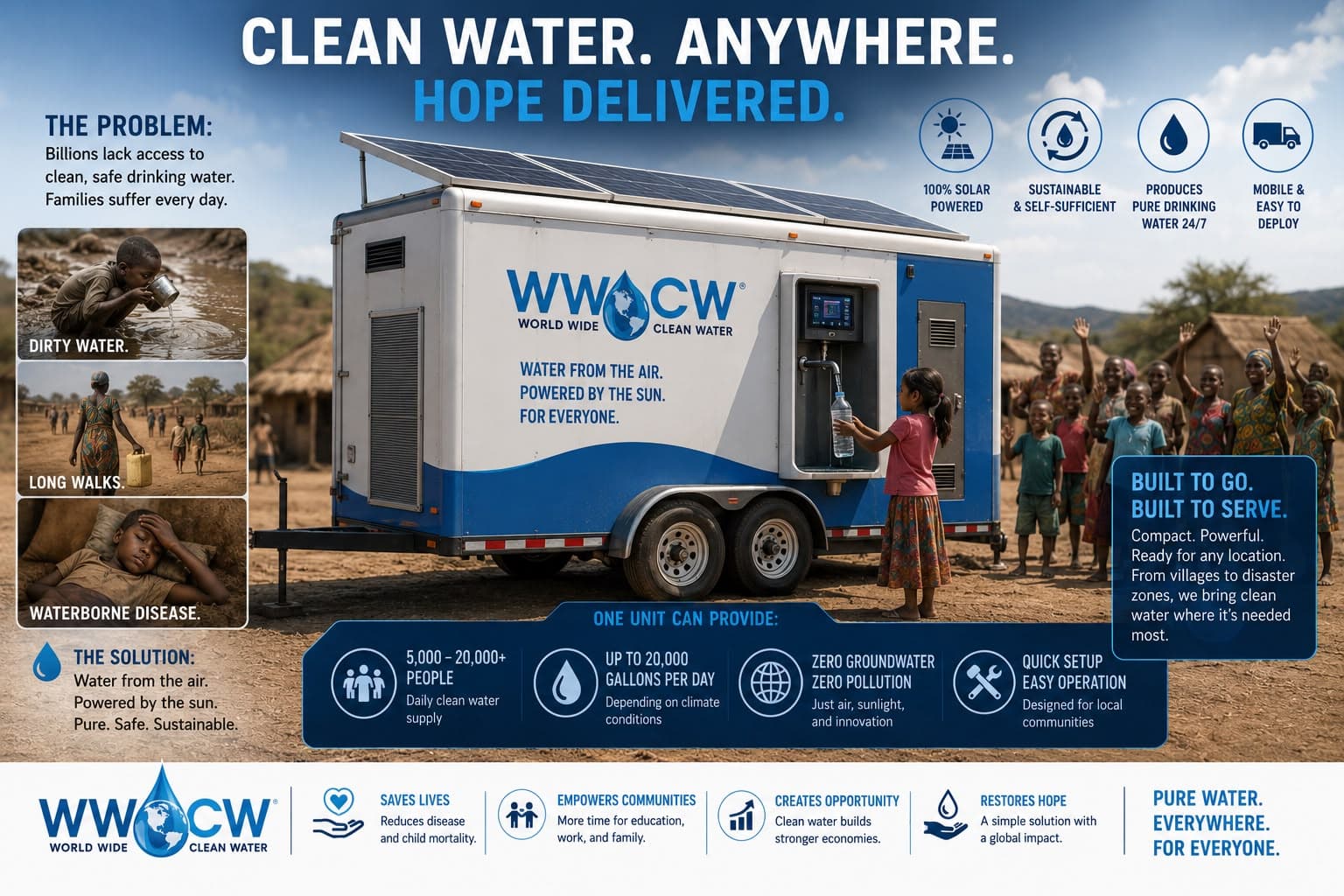
Billions of people live without a reliable, safe source of water — not because water doesn't exist, but because the infrastructure to reach it, treat it, or protect it never arrived. WWCW is designed to make water local.
A gap measured in billions, felt one household at a time.
No reliable source. A contaminated source. Infrastructure that was destroyed, never built, or too expensive to maintain. Each of these is an engineering problem before it is anything else — and engineering problems can be solved.
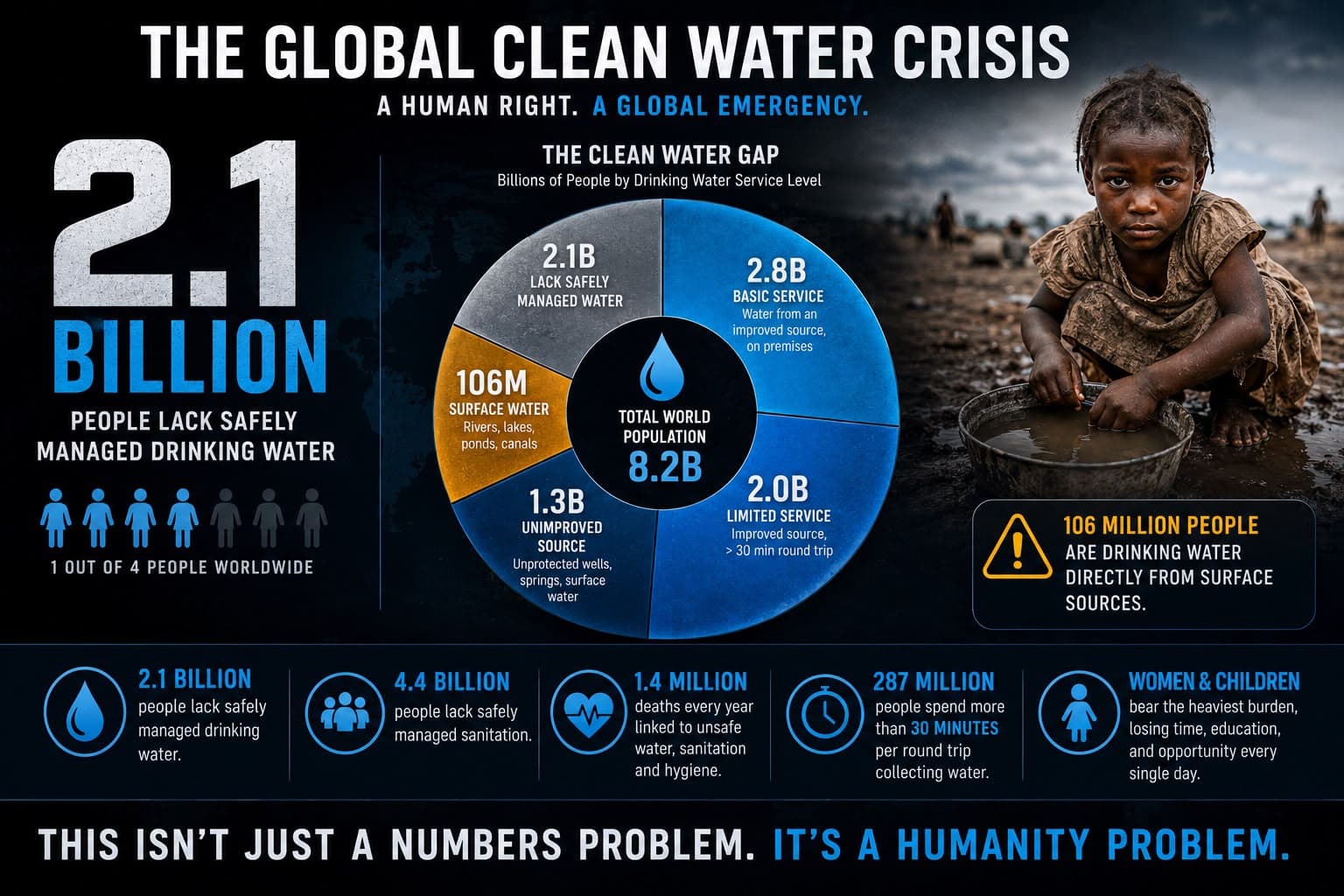
Time lost carrying water is time lost building a future.
In much of the world, collecting water is a full-time job before it is anything else — hours spent walking, waiting, and carrying, mostly by women and children. WWCW systems are designed to produce water at the point of need, so that time can go toward school, work, and family instead.
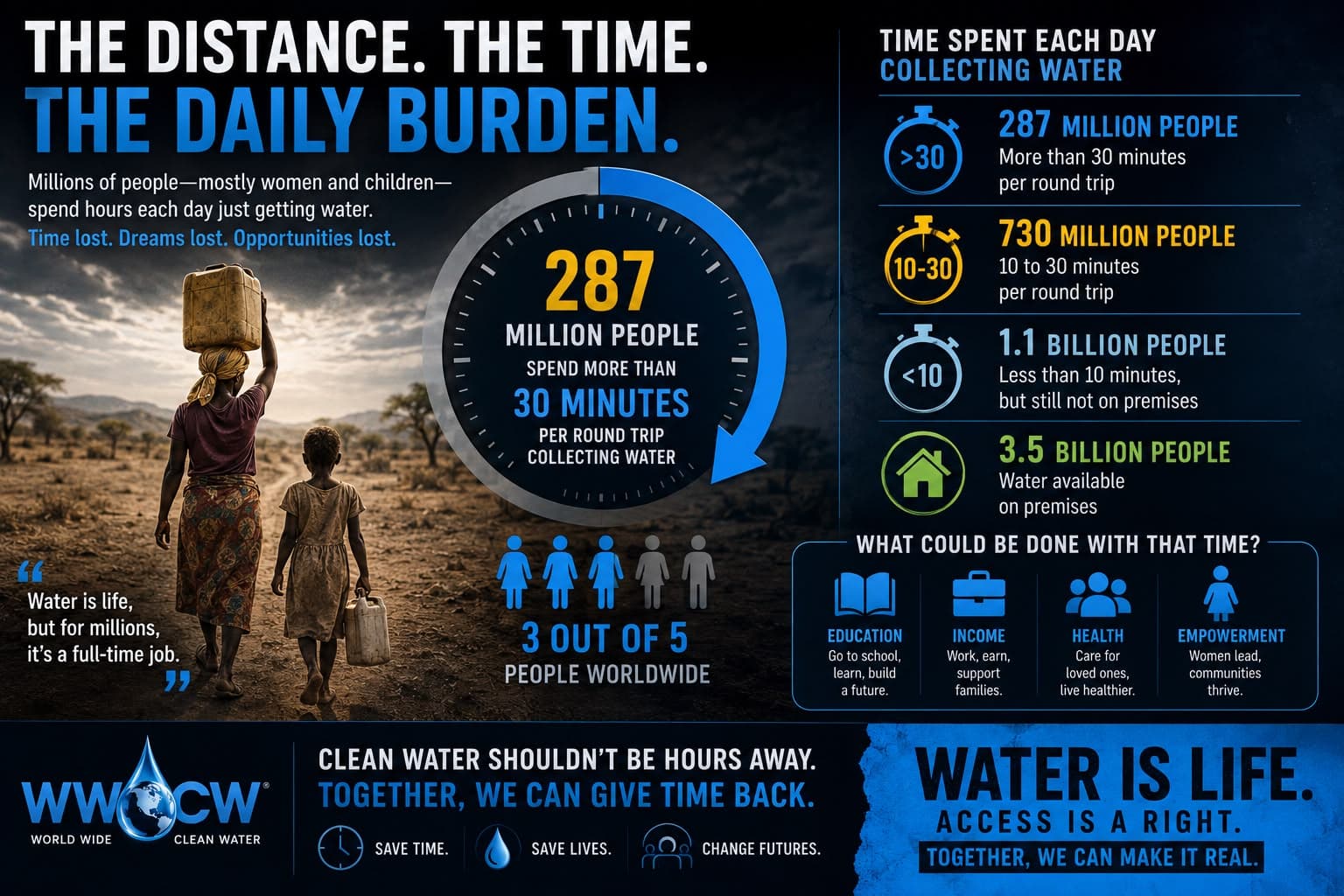
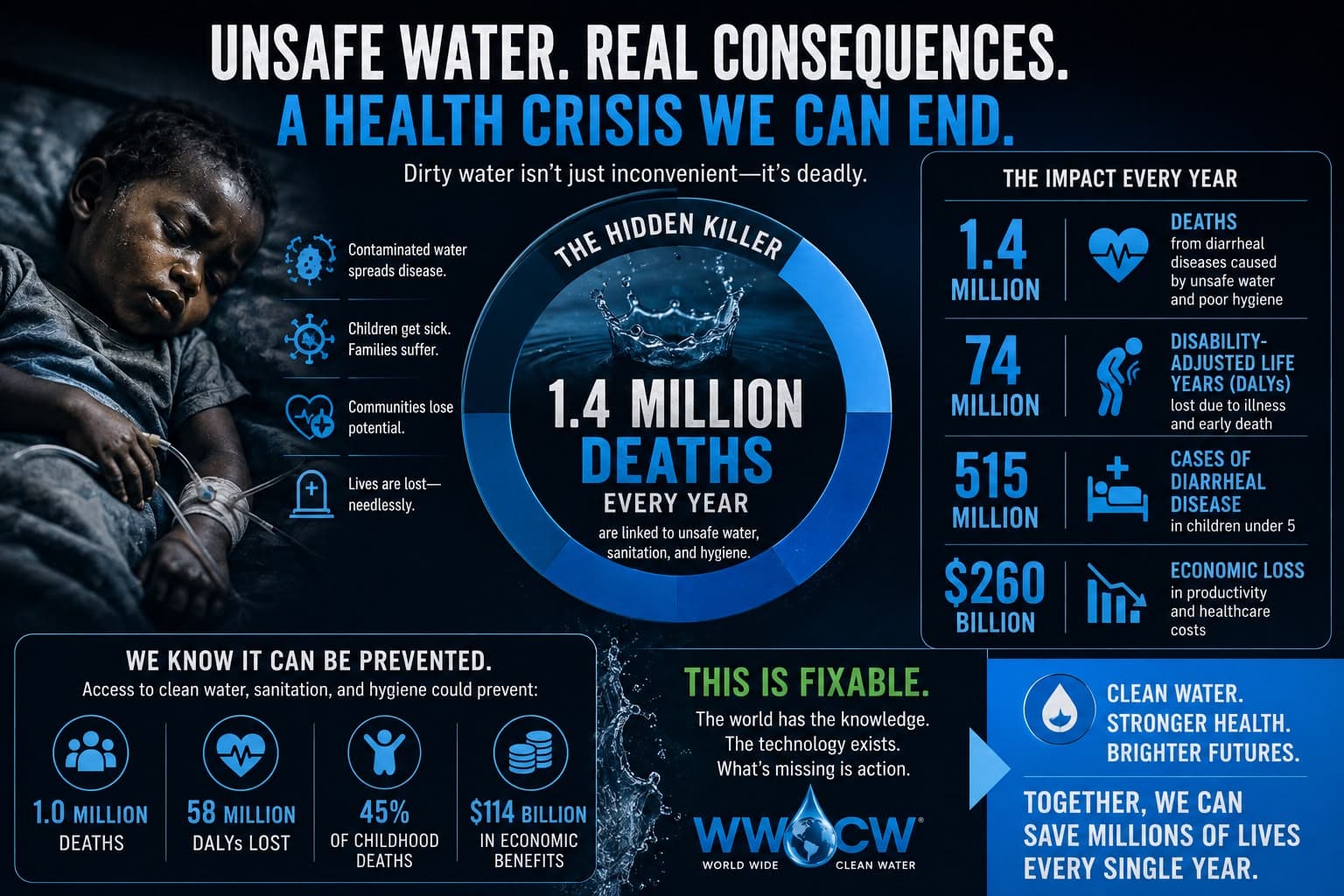
Unsafe water is not an inconvenience. It is a health crisis.
Contaminated water spreads disease long before it's diagnosed as the cause. WWCW's multi-stage treatment train is engineered around monitored, configurable filtration, sanitation, and mineralization — validated against the standard each deployment is intended to serve.
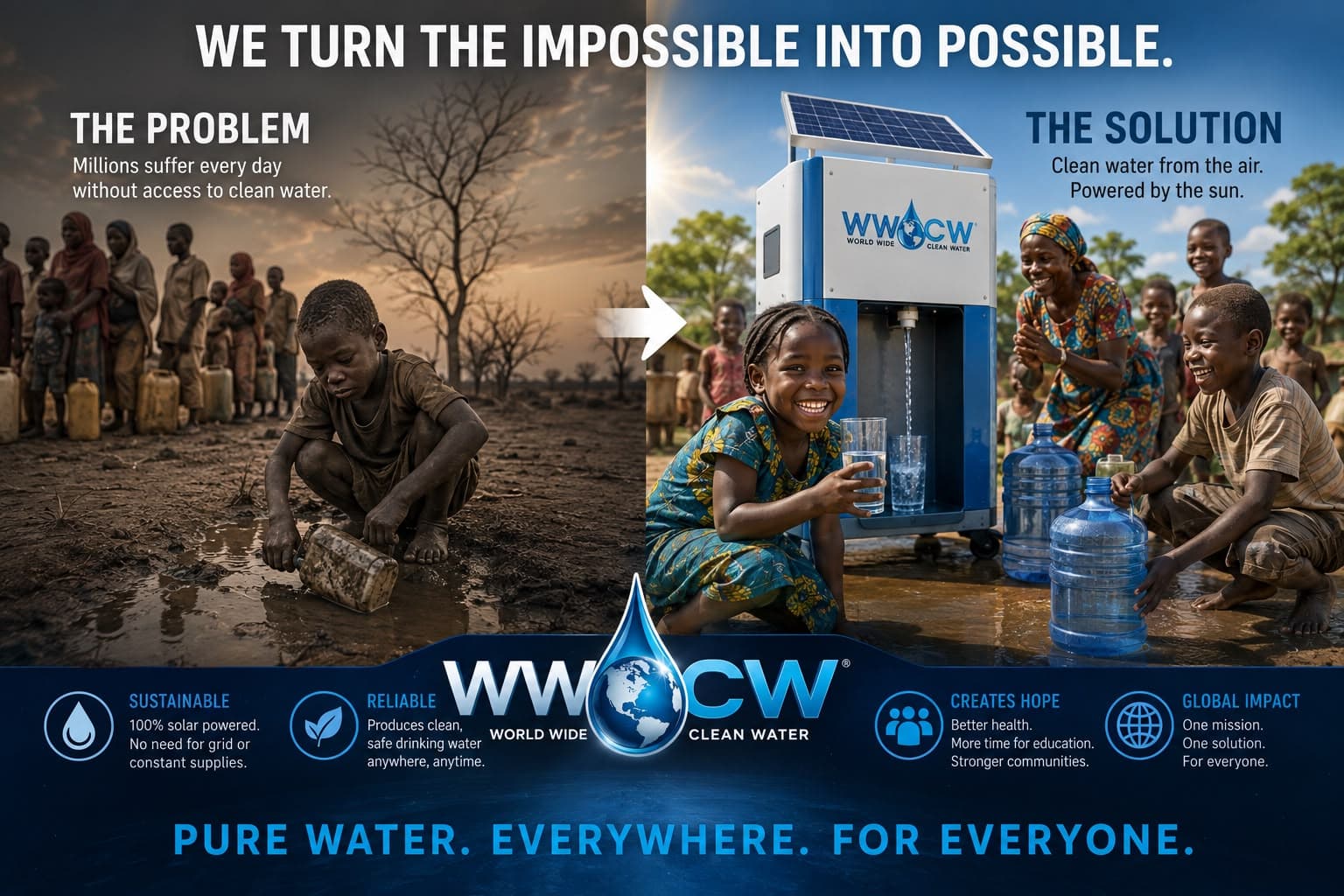
We turn the impossible into possible.
The same atmosphere that surrounds every village, campus, and disaster zone already holds the water it needs. WWCW's job is to capture it, treat it, and deliver it — reliably, and without waiting on infrastructure that may never come.
Sustainable. Reliable. Built for where it's needed.
A WWCW unit is designed to run on solar power, without a grid connection or constant resupply, producing clean water on site — turning a daily struggle into a dependable source families can return to every day.
Air in. Clean water out.
Every WWCW system follows the same engineered sequence, sized and configured to the climate, demand, and power available on site.
Air Intake
Ambient air is drawn through a protected intake and particulate pre-filtration stage.
Condensation
A controlled cooling system reduces air temperature below its dew point, causing moisture to condense.
Collection
Condensed water is captured through a hygienic internal collection pathway.
Treatment
Water passes through configurable filtration, sanitation, mineralization, and monitoring stages appropriate to its intended use.
Storage
Clean water is held in a protected reservoir, ready for local dispensing.
Delivery
Water is dispensed locally or connected to an approved downstream distribution system.
Solar-first energy. Photovoltaics and optional battery storage are designed to reduce dependence on grid electricity. Output varies with climate — every performance figure we publish will identify the temperature, humidity, and power conditions it was measured under.
From personal field units to industrial deployments.
The same atmospheric water engineering, scaled to how and where it's needed.
WWCW Portable
Personal / expedition / field
Human-portable water production with fold-out solar and replaceable filters.
Explore PortableWWCW Rapid
Emergency & disaster response
Palletized or trailerable, fast setup, integrated solar canopy, multiple taps.
Deploy RapidWWCW Community
Villages, shelters, schools, clinics
Modular rack format supporting shared storage and distribution.
Plan a Community SystemWWCW Institutional
Hospitals, campuses, government sites
Redundancy, monitoring, lockable service access, higher sanitation assurance.
Request Engineering ReviewWWCW Industrial
Large remote or high-demand sites
Scalable modules, remote telemetry, serviceable skids, hybrid power.
Speak with EngineeringWWCW Custom
Mission-specific engineering
Tailored capacity, climate, power, transport, filtration, and storage.
Start a ConversationEngineered for the places infrastructure can't reach.
From disaster response to permanent community installations, WWCW systems are designed around the same principle: produce clean water close to the people who need it, using the sun and the air already on site.
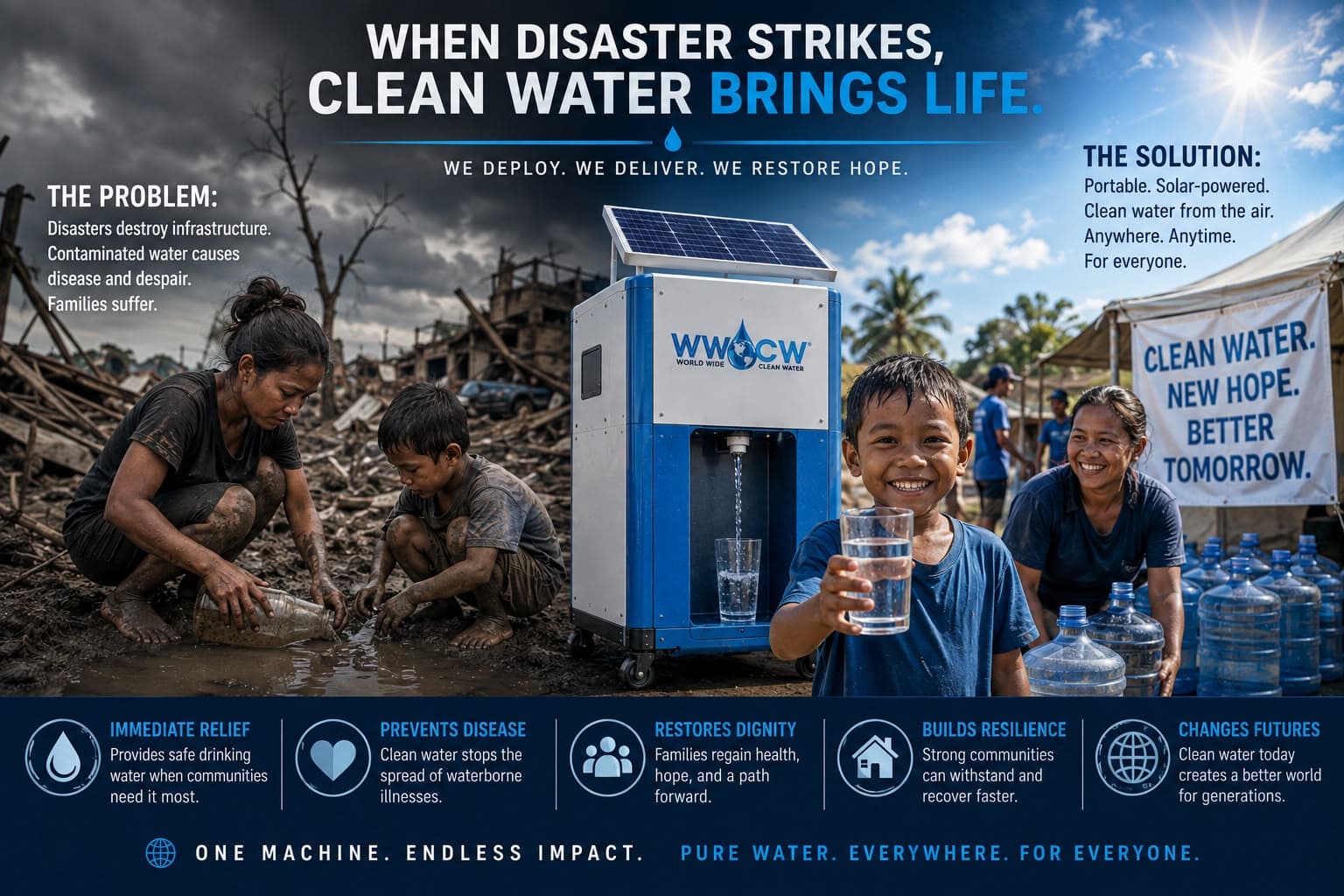
When disaster strikes, clean water brings life.
After hurricanes, earthquakes, floods, or contamination events, WWCW Rapid systems are engineered for fast setup, ruggedized transport, and immediate relief — reducing dependence on trucked-in water while permanent infrastructure is restored.
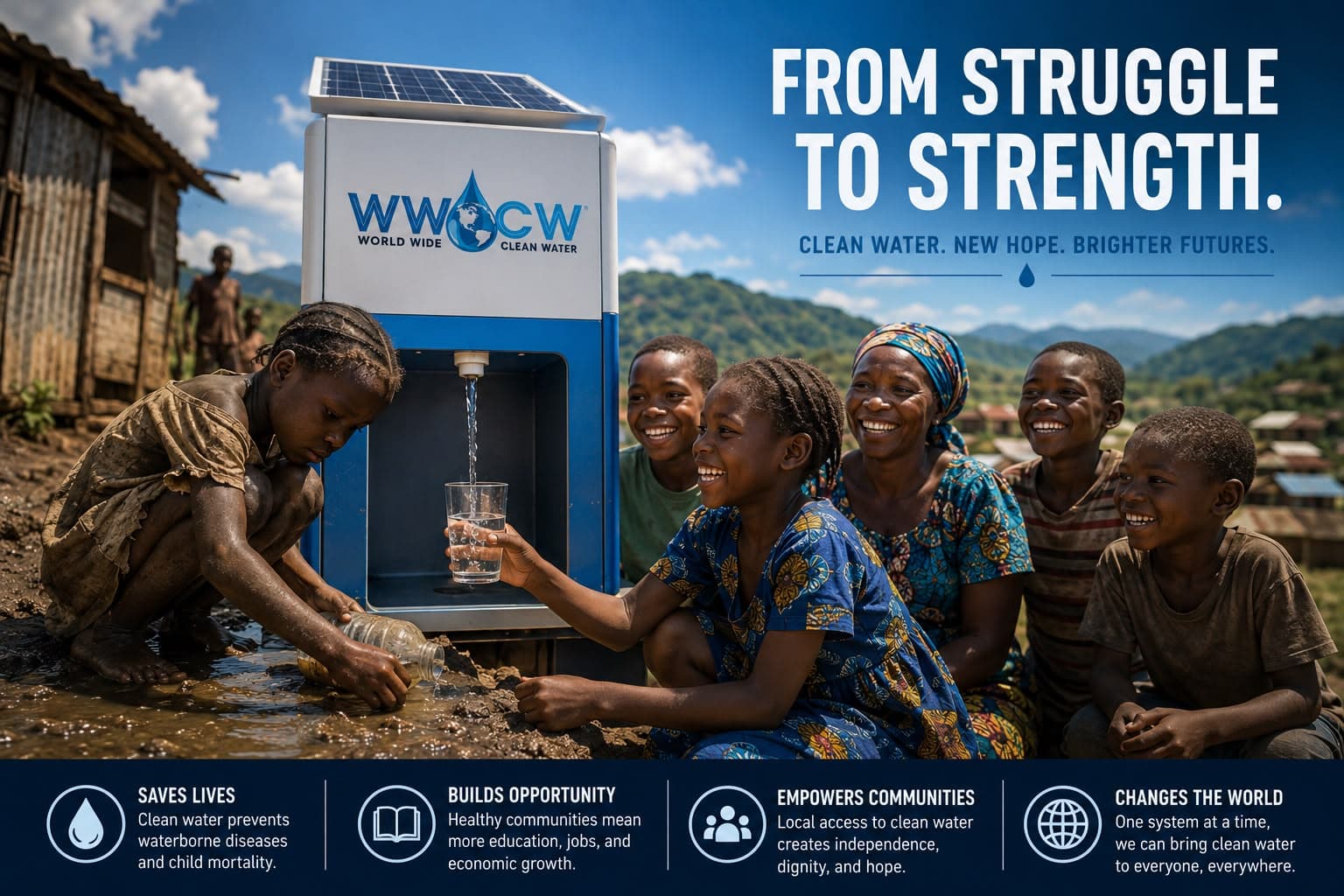
From struggle to strength.
Clean water on site changes more than a household's morning routine. It reduces disease, frees up time for school and work, and gives communities a source they can plan around instead of one they have to chase.
Clean water, anywhere hope needs to be delivered.
Trailerable, solar-powered, and built for rapid setup — WWCW's mobile configuration brings a full treatment train directly into villages, disaster zones, and remote sites, with local training and spare-parts planning built into every deployment.
Tell us where water is needed.
We'll help design the path to get it there.
Let's design the path to clean water.
Whether you're a community, NGO, government, school, or company — tell us what you need and our engineering team will follow up.
PO Box 52
Detroit, ME 04929
Mailing address for correspondence and partnership documents.
We're a nonprofit run with the discipline of a low-margin business. Lean overhead, efficient engineering, and minimal waste — so more of every dollar goes toward getting water where it's needed.